Why mats form so fast on a long haired cat, and what can be done
The coat can go from slightly clumped to solidly matted in about two weeks, and it usually happens for a reason that had nothing to do with the cat.
September 7, 2026 · 4 min read
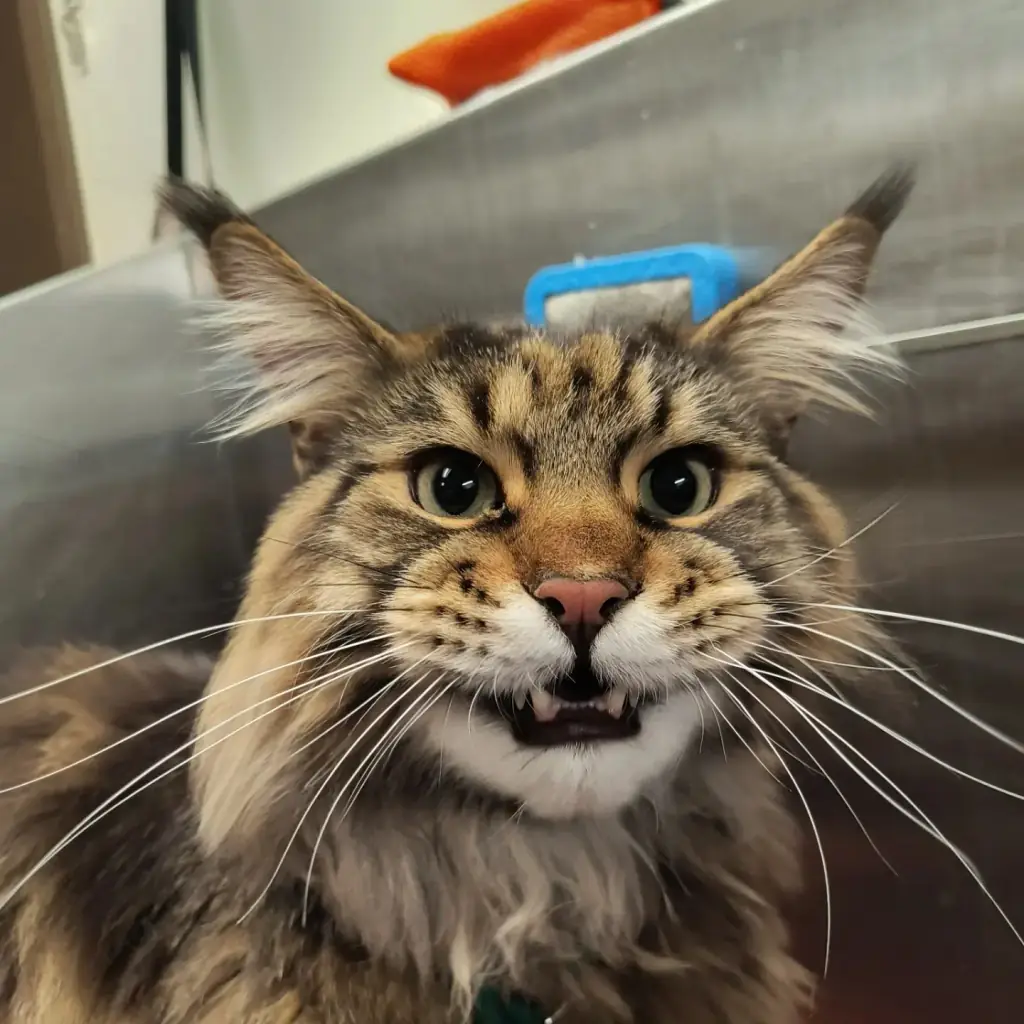
People tend to arrive apologetic. They explain that they were brushing her, and then something happened, and now there is a mat the size of a golf ball behind her elbow and they do not know how it got there so quickly.
It gets there quickly because a mat is not a big tangle. It is a different thing with a different cause, and understanding the difference changes what you do about it.
A tangle sits in the coat, a mat is anchored to skin
A tangle is loose hair caught in the topcoat. A comb opens it. A mat forms when shed undercoat, which the cat cannot get rid of on her own, felts together against the skin and then keeps compacting with every movement. Once it has done that, it is attached to a surface that moves every time she walks.
That is why pulling at a mat hurts so much, and why a cat who tolerates brushing will bite over one. You are not tugging hair, you are tugging skin. It is also why brushing the top of the coat can leave the mats entirely untouched. The brush glides over a surface that looks fine while the felted layer underneath carries on tightening.
The places it starts
Mats form first where there is friction and where a cat grooms least. The armpits and the chest, behind the ears, the belly, the inner thighs, and the britches at the back of the hind legs. Those are also exactly the places an owner is least likely to comb thoroughly, because they are the places a cat least likes being handled.
- Armpits and chest, where the leg meets the body
- Behind and under the ears
- Belly and inner thighs
- The britches and the base of the tail
It usually starts when something else went wrong
The common thread in almost every badly matted cat is an interruption. The owner was ill. Someone was in hospital. There was a move, a new baby, a bereavement, a long stretch of overtime. Daily brushing is one of the first small routines to fall away when a household is under strain, and a long haired coat does not wait.
One of our regulars described exactly that sequence in her own review: she fell sick, and it did not take long for the cat to mat. That is the normal shape of it. Nobody here treats a matted cat as evidence of neglect, and it is not a conversation you need to brace for.
Age does the same thing more slowly. An older cat, or an arthritic one, stops being able to twist round to groom her own back end. The britches and the base of the tail go first, and they go every single time unless someone is combing them for her.
Why the answer is usually to shave, not to comb out
Owners often want the mats combed out, because shaving feels drastic. Once a mat is genuinely felted to the skin, combing it out means hours of pulling on a cat who is already unhappy, and the skin underneath is frequently sore or inflamed before you even start.
Shaving the mat off takes it away in one movement without pulling. The coat grows back. A coat that has been shaved once is also much easier to keep on top of afterwards, because you are starting from an even length rather than fighting an existing felt layer.
A coat that is loosely matted or heavily shedding, but has not felted, is a different job and can often be opened up with a proper comb out or blow out instead. Which of the two you are looking at is genuinely hard to judge from the top of the coat, so it is worth having someone feel it rather than guessing.
The sedation question
This is the question most people are really asking when they call. Many veterinary clinics sedate every cat that comes in for grooming as a matter of course, especially for shaving. It is faster and their staff are set up for medicine rather than coats.
It is not the only way. Our groomer is a Certified Feline Master Groomer and a member of the National Cat Groomers Institute, and the work here is built around cats who do not need sedating. Handling, pacing and knowing when a cat has had enough for one session do most of what a sedative would otherwise be used for.
The interval that stops it happening again
For most long haired cats, a professional groom roughly every three months keeps a coat from ever reaching the matted stage. One owner has brought her long haired cat every three months for two years on exactly that basis, and the coat has never got away from her.
Between visits, comb rather than brush, and go through to the skin in the four places listed above rather than over the top of the coat. Two minutes on the armpits is worth twenty on the back.
Aristocats Hotel & Spa, (405) 607-4422
Call (405) 607-4422More articles
Boarding a cat for the first time, and what actually happens
Most of what owners worry about on the drive over turns out not to be the hard part.
Window room or quiet room: which suits your cat
Five dollars a night separates the two rooms, and for some cats the window is the whole stay while for others it is a distraction they would rather not have.